BUILD YOUR MAP TO REVENUE ON A SINGLE PAGE.
If it doesn’t move the needle, it doesn’t earn a space. Get the disciplined framework designed for instant actionable clarity. Click here!

0330 311 2820
You've just finished a job you're quietly proud of. Tight tolerances, an awkward material, a delivery date that looked frankly impossible in week one. It went out on time. It worked.
And you can't tell a soul.
Not the customer's name. Not a photograph of the part. In some cases, not even the sector, because "aerospace" plus "that sort of housing, that sort of size" narrows it down to about three possible customers for anyone who actually knows the market. So the whole thing goes in a folder, and the folder stays shut.
Meanwhile there's a firm twenty minutes down the road doing considerably simpler work, posting a photo of it every other day, and picking up enquiries on the back of it. You look at that and think well, that's just the deal. Confidentiality is the price of doing serious work.
One of the business owners we've worked with, who runs a mechanical and electrical engineering firm, described exactly this when he first came to us. He knew he needed to grow. He just couldn't see how you market a business when IP restrictions get in the way of showcasing anything you've made. It's a fair question, and it's one I hear a lot. It's also one that almost every piece of marketing advice out there quietly ignores, because nearly all of it assumes you can show the work.
Here's the thing though. The problem isn't that you have nothing to say. It's that you've been measuring your marketing against a model that was never built for you. Photos of finished parts and named logos are one form of proof. They're not the only form, and for technical buyers they're often not even the strongest one.
It also matters more than it used to. UK defence now spends roughly £5 billion a year with SMEs, about a quarter of it through direct contracts and the rest flowing down the supply chain, and there's a stated ambition to push total SME spend to £7.5 billion by May 2028. There are something like 10,000 companies sitting in the UK defence supply chain already. More money is coming into the sector, more primes are looking for capable British suppliers, and more of your competitors are going to get better at being findable. Staying invisible was survivable when work came through the same three relationships every year. It's a much more expensive habit now.
So this post is about what you can do instead. Five approaches, all of them legal, all of them used by UK firms already, none of them requiring you to breach a thing. A quick caveat before we start: I'm a marketer, not a lawyer and not an export control officer. Where I mention contract conditions or licensing, treat it as a prompt to go and check properly, not as advice you can act on directly.
This is the step nearly everyone skips, and it's the one that unlocks the rest.
Most owner managed engineering firms I meet operate on a single blanket rule that lives in someone's head and goes roughly: we can't talk about our work. Nobody wrote it down. Nobody's tested it. It got established years ago after one uncomfortable phone call from a customer, and it's been treated as gospel ever since.
But "we can't talk about our work" is actually four completely different restrictions wearing the same coat, and they don't overlap as much as you'd assume.
Contract confidentiality. MOD contracts handle disclosure through a standard condition, DEFCON 531, and commercial customers use their own confidentiality agreements. These vary enormously. Some genuinely forbid any mention at all. Plenty only forbid naming the customer, or disclosing pricing, or discussing the specifics of the deliverable. Have you actually read yours recently, or are you working from memory of what you assumed it said?
Intellectual property restrictions. Separate thing. MOD contracts flag IPR restrictions through their own conditions and a schedule listing what's restricted. In commercial work, the drawing usually belongs to the customer, and the design is theirs. But your process for making it to that tolerance repeatedly, at that yield, with that inspection regime? That's frequently yours.
Classification. If material is marked as sensitive or above, that's a hard boundary with its own handling rules, and it isn't a marketing judgement call.
Export control. This is where I see the most confusion, and it's worth being precise, because most people get the risk backwards. UK export controls cover the transfer of controlled technology out of the country, and crucially that includes intangible transfers. Emails containing controlled technology need a licence based on where the recipient is. Presentations, live or recorded, that display controlled technology to someone overseas need one too. A technical detail read out on a video call can count.
Now, here's the bit that surprises people. Publication itself is generally not controlled, unless the material is separately restricted by contract or contains classified information. So the exposure often isn't your website at all. It's your sales director on a Teams call with a prospect in Germany, cheerfully walking through a technical spec because it feels like a conversation rather than an export.
I've watched a firm spend eight months paralysed about whether they could put a general capability statement on their homepage, while running exactly that kind of call every fortnight without a second thought.
What to do about it: sit down for two hours with whoever holds the contracts and build one document. Call it "what we can say." Three columns: always fine, needs sign off, never. Populate it from the actual contracts, not from folklore. Get it checked by someone qualified once, then let your marketing run inside those lines without fresh anxiety every single time.
Almost everyone who does this finds the permitted column is much wider than they'd been behaving as if it was. That alone is often worth the afternoon.
Once you know your boundaries, the strategic shift is straightforward, even if it takes a while to get used to.
Stop trying to market the job. Market the capability.
Your prospect doesn't actually care about your last customer. They care about one thing: can you do my job, reliably, to spec, on time. The finished part photo is only ever a proxy for answering that question. If the photo is off limits, answer the question directly instead. It's arguably a better answer anyway.
This matters because of how technical buyers now behave. Research into engineering and technical buyers found they spend around 62% of the buying journey researching online before they engage with anyone. Separate work suggests 95% of B2B buyers end up purchasing from a vendor that was already on their day one shortlist, a list of roughly four names drawn up before a single supplier was contacted. In manufacturing the average sales cycle runs about 130 days with more than six people involved in the decision.
Read that again, because it reframes the whole problem. You're not competing to win a pitch. You're competing to be on a list that gets written in a meeting you'll never attend, by people using information you didn't hand them personally. If you're not visible and legible during that phase, the quality of your work is irrelevant, because you never get asked.
So what does capability led content look like in practice? Concrete, specific, and unglamorous.
Publish your envelope. Machine list, axis counts, bed sizes, achievable tolerances, materials you work with regularly and materials you don't, batch sizes you're set up for, typical lead times, your inspection kit. Not marketing language. Just facts a specifier can check themselves against their drawing at eleven at night.
Write about the problems, not the projects. "What to check before sending us a titanium part for the first time." "Five things that make a fabrication drawing expensive to quote." "Why your tolerance callout might be adding 30% to your unit cost, and how to tell." None of that touches a customer's confidentiality. All of it demonstrates that you know what you're doing, to exactly the audience that can tell the difference.
And here's the easiest content source in your business, which almost nobody uses. Every RFQ that comes in generates questions. Your estimator asks the same five things over and over because customers keep leaving them off. That list of five questions is a genuinely useful article, and you already own it. Nobody else is publishing it because everyone assumes it's too boring. It isn't boring to a buyer trying to get their drawing package right.
To be honest, the hardest part of this isn't the writing. It's the belief. Technical people are often convinced this material is too obvious to be worth publishing. It's obvious to you because you've done it for twenty years. That's precisely why it's valuable.
BUILD YOUR MAP TO REVENUE ON A SINGLE PAGE.
If it doesn’t move the needle, it doesn’t earn a space. Get the disciplined framework designed for instant actionable clarity. Click here!
Anonymised case studies get a bad reputation, mostly because most of them are terrible.
You've read them. "We helped a leading European manufacturer improve efficiency and reduce costs." That sentence proves nothing, commits to nothing, and could have been written by someone who has never seen a machine. Buyers skim straight past it. Which then reinforces the belief that anonymous case studies don't work, when actually what doesn't work is vague ones.
The trick is a swap. You lose the identity, so you compensate with precision everywhere else.
Instead of naming the customer, define the environment they were operating in. Regulatory pressure. Certification requirements. Production complexity. Tolerance regime. The stage the business was at. Something like: a medical device business moving from prototype into regulated volume production, needing tight temperature control tolerances held across every batch, with full traceability. Nobody's identified. Everything meaningful is still there. And the reader who is in that exact situation recognises themselves immediately, which is the entire job of a case study.
A few practical rules that keep this both effective and safe.
Use a descriptor, not an invented company name. "A tier two aerospace supplier" reads as honest. "Meridian Systems Ltd" reads as fabricated, because it is.
Watch the combination, not just the details. Any single fact might be harmless. Sector plus region plus rough turnover plus part type can add up to a fingerprint. Apply what I'd call the competitor test: if a well-informed rival in your sector read this, could they name the customer? If yes, keep generalising.
Use ranges and percentages, not exact figures. Scrap rate down by roughly a third. Lead time cut by four weeks. Precise numbers are more identifying than people expect, and they're rarely more persuasive.
Then get it approved and frame the ask carefully. Don't email your customer's procurement lead asking permission to publish a marketing case study, because the safe answer to that question is always no. Send them the anonymised draft and ask whether it accurately reflects the work while properly protecting their confidentiality. Different question. Much better response rate. You're inviting them to redline something rather than approve a risk.
And if approval is genuinely impossible, build composites. Take five similar jobs, strip them all back, and write one thematic piece about how you approach that class of problem across the sector. No single customer to approve, no identity to protect. Just say clearly that it's drawn from multiple projects. Honest, and still useful.
Here's a reframe that lands well with technical buyers, and I've seen it change a firm's whole content approach in an afternoon.
Nobody signs off a supplier because of one nice photo of a finished part. They sign off a supplier because they believe that supplier will do it right, repeatedly, and tell them promptly when something goes wrong. That's the actual purchase. Confidence in a process.
And your process, almost always, is yours to talk about.
You can film the shop floor with a nondescript test piece in the vice. You can show the inspection room, the CMM, the calibration records, the way goods in gets logged. You can walk through what happens when a drawing arrives with an error in it, because how you handle that says more about you as a supplier than a hundred perfect parts. You can explain your traceability, your nonconformance procedure, your first article inspection routine, how you decide whether to take a job on at all.
You can even publish your quoting process. What happens in the first hour after an RFQ lands. Who looks at it. What you'll come back with and when. That sounds mundane. To a procurement manager who has been burned twice this year by suppliers who went silent for a fortnight, it's genuinely reassuring.
There's a bonus here too. Every one of those things is something a buyer would otherwise have to ask you in a supplier assessment. Answering them upfront shortens your own sales cycle and makes you look like a business that has its house in order, which, as it happens, is exactly what you're claiming.
One small warning from experience. Check your background before you film anything. Whiteboards, job travellers on the bench, part numbers on a rack, a customer logo on a delivery crate in the corner of shot. I've seen a lovely piece of factory footage that had a full production schedule visible on the wall for eleven seconds. Do a walk round with a camera and fresh eyes first. It takes ten minutes and it saves an awkward conversation.
When you can't point at your own portfolio, you lean on validation that comes from somewhere else. And for this audience, that's not a consolation prize. Around 86% of engineers actively seek third party sources when researching products, and technical publications now sit at least level with supplier websites as the most trusted source of information. Independent validation was always going to beat self promotion with this crowd.
Accreditations do a lot of heavy lifting. JOSCAR, the Joint Supply Chain Accreditation Register, was set up by ADS Group and is used by primes across UK aerospace, defence and security to find suppliers who've already been checked out. It covers capability, accreditations, information security, financial history, ethics and responsible business practice. It's not mandatory everywhere, but it puts you in front of buyers actively searching for qualified suppliers, which is a rather different position from hoping someone finds your website.
The same applies to cyber credentials, and there's a deadline worth knowing about. DEFCON 658 flows cyber security obligations all the way down the defence supply chain, and it doesn't weaken as it goes. The MOD has asked industry partners to reach the entry level of its Defence Cyber Certification scheme by the end of December 2026, with Cyber Essentials as the prerequisite. If you're in that chain and haven't started, that's a live commercial risk, not just an IT job. And once you have it, say so, prominently. Half your competitors will still be scrambling.
Add your ISO certifications, sector standards like AS9100 for aerospace or ISO 13485 for medical, and any NATO or supplier codes you hold. To an outsider it's alphabet soup. To a specifier it's a rapid, verifiable answer to "can I even consider these people."
Trade bodies and trade press. Membership of ADS, Make UK Defence or a regional defence cluster gives you a directory listing, an audience and a route to primes. Trade publications need technical contributors constantly and are far more accessible than most engineering firms assume. A 900-word technical piece under your engineering director's name, in a publication your buyers already read, carries more weight than a month of company posts.
Make the people visible, since the work can't be. You may not be able to show the part, but nothing stops your chief engineer from having a proper professional presence and answering technical questions publicly. Buyers trust named humans with visible expertise. It's also the single cheapest asset here, and a fair few firms find it outperforms everything else they try.
And then build the proof pack you never publish. This is the piece most firms miss entirely. Not everything has to be public. Assemble a detailed capability document with the named references, the specifics, the real numbers, and share it under a confidentiality agreement at the right point in the sale. Public content gets you onto the shortlist. Private proof wins the shortlist. Two different jobs, two different assets. Your quiet portfolio isn't wasted; it's just further down the funnel than you thought.
None of this is a workaround or a compromise. Once you've spent a bit of time on it, capability led content aimed at technical buyers is simply a better fit for how these purchases actually happen than a feed of finished part photos ever was. Your constraint pushed you towards it. That's not the worst outcome.
So, quickly, the five things.
Find out what you're genuinely restricted from saying, in writing, because it's almost always less than the rule in your head. Market your capability rather than your completed jobs, in the specific, unglamorous detail that a specifier can actually use. Write anonymised proof that swaps identity for precision, and get it redlined rather than approved. Show your process, because process is what a buyer is really purchasing. And borrow credibility through accreditations, trade bodies, trade press and named experts, while keeping a private proof pack for the conversations that have earned it.
Don't try to do all five at once. That never works, and you've got a business to run.
Pick the one where you felt something. Maybe it was realising you've never actually read the confidentiality clause you've been obeying for six years. Maybe it was the thought of the RFQ questions your estimator repeats every week that would make a perfectly good article. Start there. One thing, done properly, beats five things half started, and you'll know within a couple of months whether it's moving anything.
The thing I'd leave you with is this. Confidentiality has probably cost you more work than you realise, and not because anyone chose to exclude you. It's because a shortlist of four names got written somewhere without yours on it, and nobody involved will ever know what they missed. That's a quiet, invisible sort of loss. It doesn't show up on any report. It just looks like a slightly thinner order book than you expected, year after year.
You don't have to breach a single agreement to fix it. You just have to stop letting the one thing you can't show define everything you don't say.
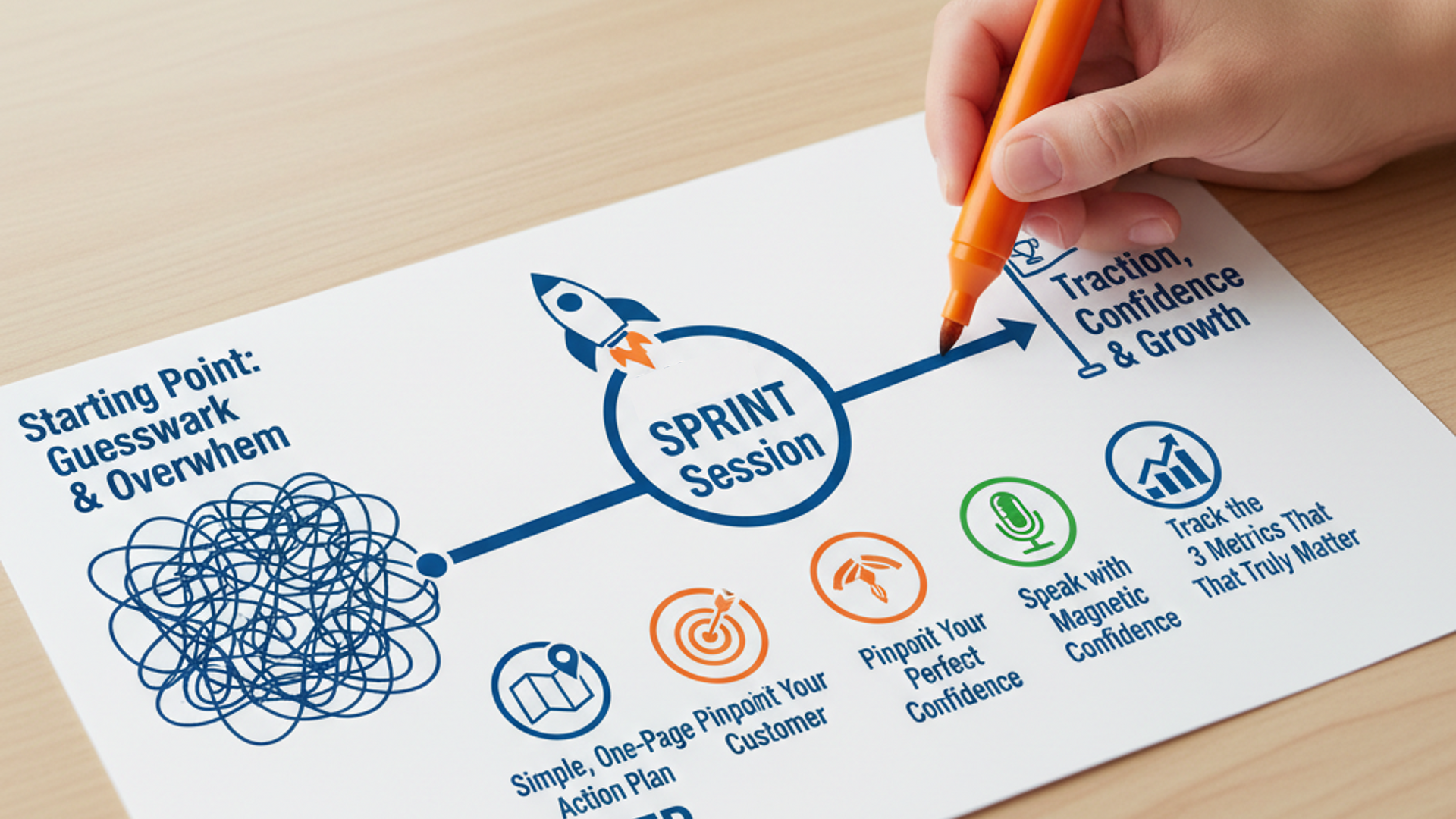
If you've read this and recognised your own business somewhere in it, that's usually the moment worth acting on. Working out precisely what you can say and then turning it into a marketing plan you can actually run with the people you already have, is exactly what our Pathfinder Marketing Sprint is built for. It's a focused working session for owner managed manufacturing and engineering firms, where we map your real buying journey, work out where your permitted ground actually sits, and leave you with a practical 90 day plan rather than another list of things to get round to. You can find out more and book a place on the
Pathfinder Marketing Sprint.
Pay It Forward! Sharing Is Caring!