Our Own Internal Talk

Adam Payne • 22 June 2022

Negative thoughts can be the Bane of Your Existence.


How positive and motivated are we this week, #BlueMonday (apparently the most depressing day of the year, no evidence on that).


But it did get me thinking about our own thoughts and how we talk to ourselves internally, remembering the quote from Napoleon Hill


"You will never be greater than the thoughts that dominate your mind."


this is very close to heart, having gone through some very dark days when I first started out, your thoughts are a powerful force, both negative and positive.


For anyone struggling there a number of re-framing techniques to try: two here

Interrogative Self-Talk

You know that feeling when you catch yourself saying something negative about yourself?


It's like a little voice inside your head that's chirping at you, "You're not good enough!" or "You'll never be able to do this." And it's right there, right in front of you. You can feel it.


But what if we could take alternative view? Switching things about!


When you hear those voices saying "You're not good enough!" or "You'll never be able to do this," try turning them into questions and asking yourself: "What would happen if I was good enough?" or "How could I make myself better?" or even better: "What does 'good enough' look like?"


Asking questions opens exploration and possibility—this self-inquiry fires up the problem-solving area in your brain tapping into your innate creativity. The more you ask yourself questions, the more likely you are to find solutions to your problems! And once you do find those solutions, then who knows what else might open up?

Here’s some examples:


  • What can I do better?
  • When have I done this before?
  • Where will I do it?
  • How can I…?

Name it to Tame it! - Dr. Daniel Siegel

Negative thoughts can be the bane of your existence. They can make you feel like you're constantly falling short and never doing enough. But what if we told you that negative thoughts are just stories in your head?


That's right: they're not real! They're just little words that your brain comes up with to try to help you explain why things aren't going so well. And we know how that goes—it can feel like these stories are REAL and TRUE, but they're actually just stories.


So how do you deal with them? One way is to "Name it to Tame it!" When a negative thought pattern enters your head simply ‘LABEL’ the story.


For instance, one of my stories often is, “Who am I to be putting myself ‘out there’ teaching people how to build their business. Aren’t you supposed to be PERFECT first!?


This is massively unhelpful for me, so when thoughts come up along that storyline, I simply mentally note to myself, "Oh! the ‘you’re not good enough’ story” and then I let it go.


I get out of my head into my life and life around me.


If you are really struggling with negative thoughts, don't do what I did and keep it to yourself, seek out someone talk to.


#mindset #bluemonday #positivity #BGAUK
by Adam Payne • 11 November 2026
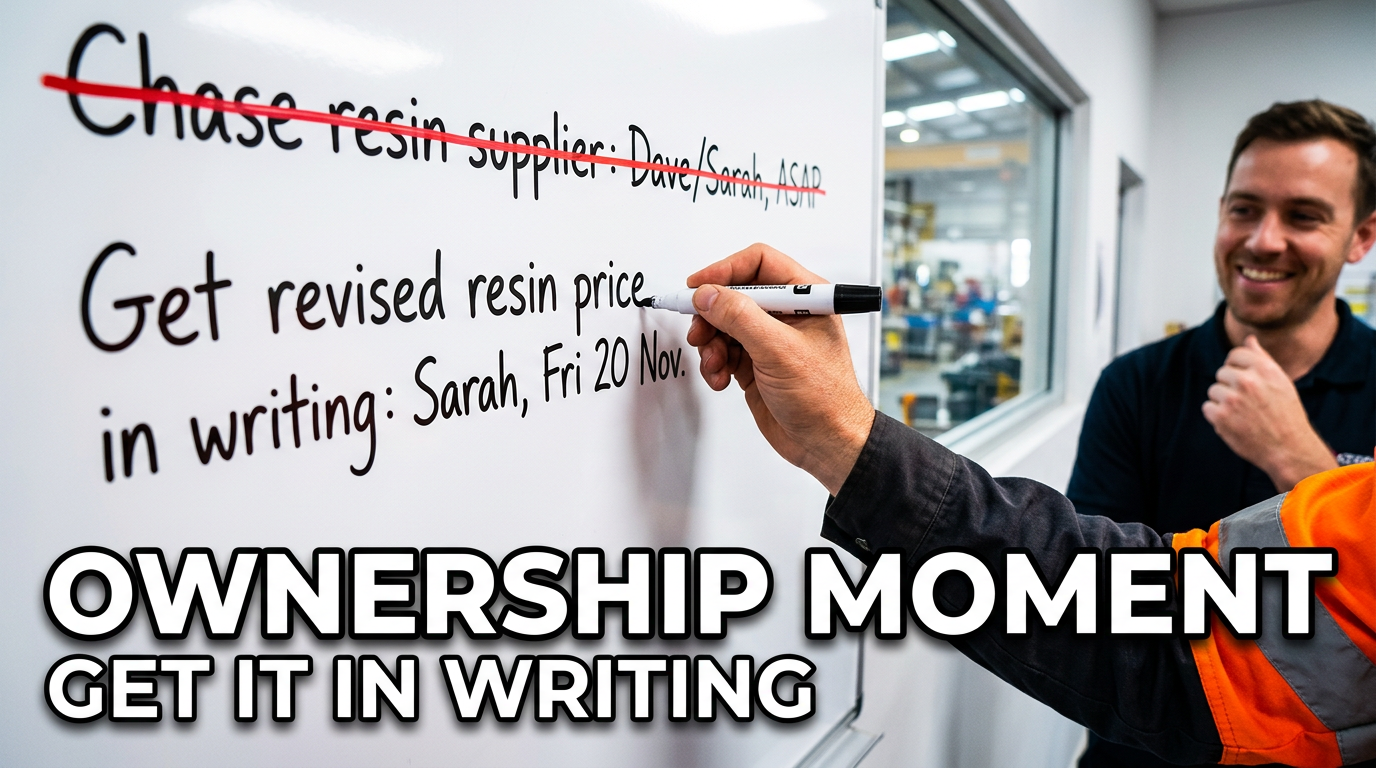
UK manufacturers turning over £3m to £25m: an action with several owners and no date rarely gets done. The One-Line Test says every action needs one name and one date, and data on tracked actions shows owned, dated items finish about 90% of the time versus roughly 50% without.
by Adam Payne • 4 November 2026
Why do good plans die in week three? For UK manufacturers turning over £3m to £25m, the fix is cadence, not commitment: weekly huddles, named owners and three priorities.
by Adam Payne • 28 October 2026
A show week guide for UK manufacturers and engineering firms on what to do with the business cards collected at NEC exhibitions such as Advanced Engineering: capture notes on the stand, send a personal note within two working days, then sort every lead by fit, capacity, margin and payment risk before quoting.
by Adam Payne • 21 October 2026
A two day strategy session only pays off for UK manufacturers and engineering firms turning over £3m to £25m if it changes where your leadership team’s attention goes. Discover four outputs worth closing the diaries for: one clear direction, a boundary list, one strategic uncertainty and measures that run by exception.
by New Way Growth • 14 October 2026
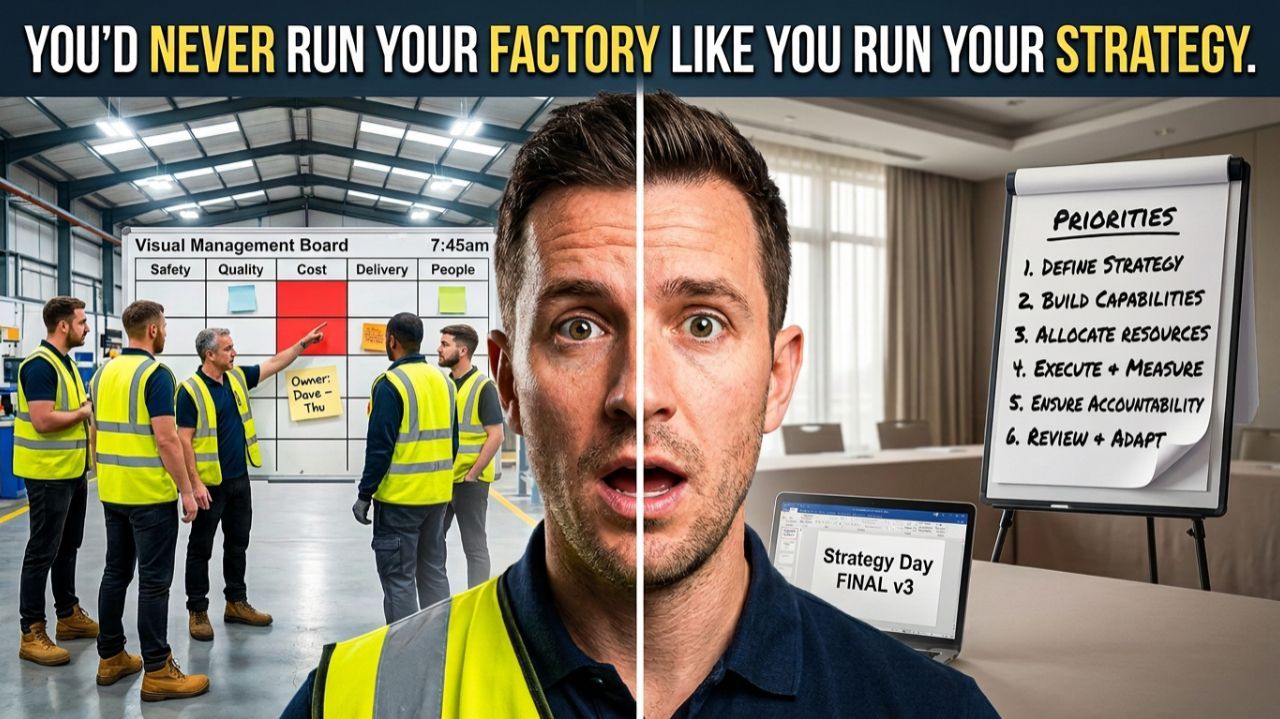
UK manufacturers run their shop floor on daily boards, fixed rhythms and root cause analysis, yet run strategy through an annual away day, so priorities quietly fade within weeks. This post explains why strategic drift starves margin work first, and how applying production disciplines stops a plan becoming a document.
by Adam Payne • 7 October 2026
Why directors of UK mid sized manufacturers often disagree about what's capping growth without realising it, what that hidden misalignment costs in split budgets and stalled initiatives, and how the Four Answers Test reveals it in one 45 minute meeting using a scored alignment total and a confidence gap.
by New Way Growth • 30 September 2026
A quiet diagnostic exercise for MDs of UK medium sized manufacturers: list every decision you made last week, mark those that reached you through habit, history or a missing written rule, then note how long each one waited, to see how much critical knowledge runs through too few heads.
by Adam Payne • 25 September 2026
Follow one £186,000 UK manufacturing contract from quote to bank and see exactly where the margin goes: a discount agreed in the last five minutes, stale material prices, panels scrapped after a drawing revision, ten days of invoice drift, a bounced part number and five months funding someone else's business.
by Adam Payne • 17 September 2026
UK manufacturing growth numbers get committed in the boardroom, the bank, to a group MD or across the kitchen table, while the capacity, decision rights and reporting lines needed to deliver them are quietly assumed rather than built. A practical look at where that gap comes from and what closing it actually requires.
by Adam Payne • 9 September 2026
UK manufacturing firms stall at roughly £3m, £10m and £25m for structural reasons, not effort. This guide explains each growth ceiling, the warning signs (decisions queueing on the owner, revenue rising while margin flatlines, knowledge trapped in 3 or 4 heads), and the specific changes that break through each one.