10, 30, 60, 90: Why the 10 Day Check Matters More Than the 90-Day Review
What the check in rhythm is really for, and why the first ten days decide whether your 12-month
objectives ever leave the meeting room.
It's day 90. The leadership team's back round the table for the quarterly review, and the MD has the OKRs up on the screen. Objective two: grow aftermarket revenue to 30% of turnover within 12 months. The first key result for this quarter was an extra £150,000 of aftermarket sales.
It's come in at about £40,000.
So you go round the table. The sales director has spent the quarter signing up two new distributors. That's real work, and he's quite proud of it. The operations director looks puzzled. She'd assumed aftermarket meant the refurbishment service, the one the workshop has been asking to grow for years, so she ring fenced two fitters and a test rig for it. They've spent most of the quarter waiting for work that never came, because nobody was out selling it.
So there you have two capable directors, one objective and two completely different plans, and it's taken 90 days, plus a fair chunk of the workshop's capacity, to find out.
Here's the bit that stings. Nothing in that review needed 90 days to discover. If somebody had asked both directors on day 10, "what's the first thing you're doing on this one, in your own words?", the gap would've been obvious in about four minutes.
That's what this post is about. Our Implementation Engine runs on a rhythm of check-ins at 10, 30, 60 and 90 days. Most people assume the 90 is the big one, because it's got the scorecard, the red and green, and that slightly nervous atmosphere you get whenever numbers are about to be discussed in public. To be honest, I used to think that too. I've sat through a lot of quarterly reviews, on both sides of the table, and I've slowly come round to the opposite view.
The 90-day review tells you what happened. The 10-day check decides what's going to happen.
At day 10 the job isn't to measure progress, because there's hardly any yet. The job is to make sure your leadership team genuinely agrees on its 12-month objectives and key results, and on the first 90 days of actions that will move them. Agrees, mind you. Not nods.
So let's look at why the start matters so much, why a nod in a meeting room isn't the same thing as agreement, what a good 10-day check actually looks like, and what the 30, 60 and 90 are for once you've got day 10 right.
Plans don't go wrong, they start wrong
Bent Flyvbjerg, an Oxford professor, has spent his career studying why big projects fail. His database covers more than 16,000 of them. Only 8.5% came in on budget and on time. Only half of one percent came in on budget, on time and delivered the benefits they promised.
His explanation is the bit I find useful, though. He argues that projects don't really go wrong in the middle. They start wrong. Teams rush from the idea to the doing, because doing feels like progress, and the planning ends up quick and shallow. The problems that a bit more thinking would have exposed don't disappear. They just turn up later, in delivery, when they're far more expensive to fix. His phrase for what the good ones do is "think slow, act fast." Thinking is cheap, so that's where you put the effort.
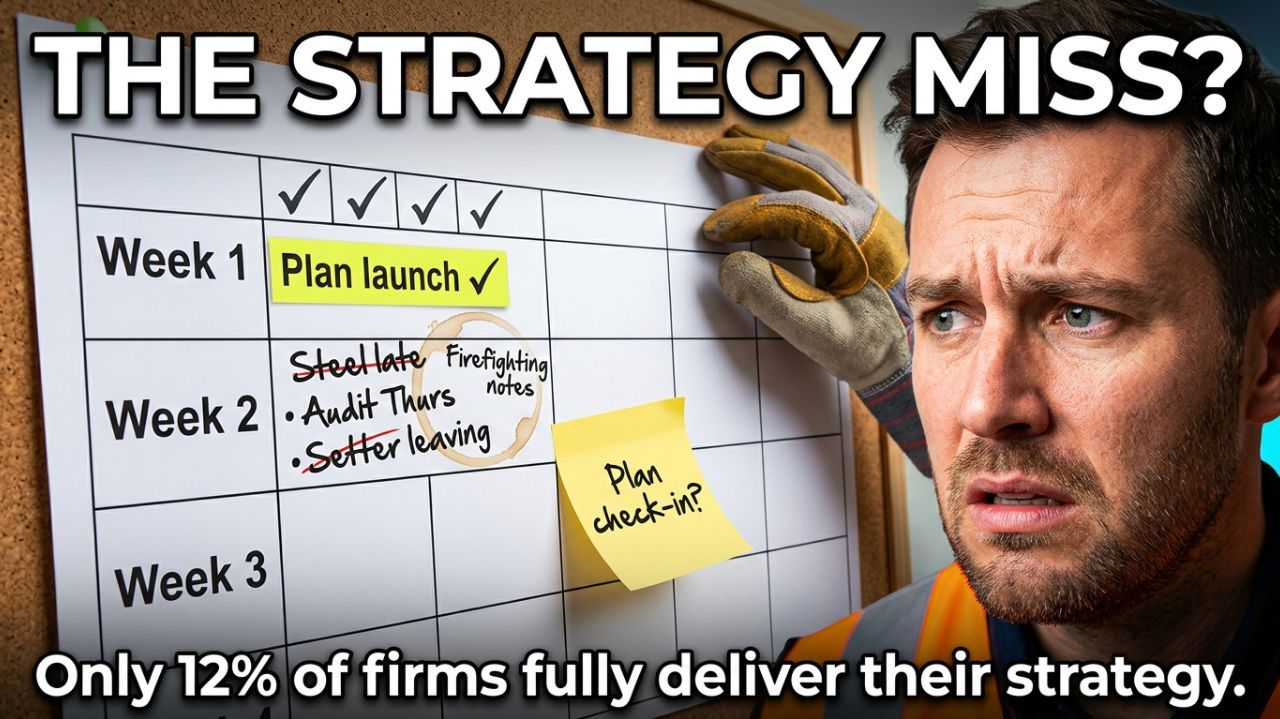
Now, your 12-month OKRs aren't a new railway line. But I think the pattern holds at any size. The strategy day ends, everyone's tired and a bit relieved, and the plan gets launched into a busy Monday before anyone's checked that it actually hangs together.
I remember sitting in a quarterly review early in my career where we spent the best part of two hours explaining why one of our priorities hadn't delivered. There were charts, competing theories and a fair bit of defensiveness, and by the end it was pretty clear the thing had quietly died in week two. A key assumption was wrong from the start, and nobody had looked. We weren't reviewing a failure. We were holding a postmortem on something that had never really been alive.
You already know the economics of this from the factory floor. Most quality managers can recite the 1:10:100 rule. It costs £1 to prevent a defect, £10 to correct it before it leaves the building, and £100 once it's reached the customer. Every stage a problem passes through multiplies the cost.
A plan works the same way. A misunderstanding caught at day 10 costs you a conversation. At day 45 it costs six weeks of people doing the wrong work. At day 90 it costs a quarter of capacity, plus something harder to put a number on: your team's belief that the plan means anything.
There's another reason the start matters, and it's a bit uncomfortable. Back in 1988, a researcher called Connie Gersick followed eight project teams through their whole lives and sat in on every meeting. What she found was that each team settled on its approach almost immediately, in its very first meeting, mostly through assumptions nobody actually said out loud. And then that approach held, with very little change, for about half the time the team had. Only at the midpoint did they stop and properly rethink. That happened whether the project lasted a week or six months.
Think about what that means for a 90-day plan. Whatever your team half agreed in the workshop is what it'll run on until roughly day 45. The unspoken assumptions included. The 10-day check is your chance to drag those assumptions into the open before they set.
And the longer you leave it, the harder it gets to change course. Barry Staw's research in the 1970s on what he called escalation of commitment suggested that people who feel personally responsible for a decision tend to keep investing in it, even when it's going badly. I'd hold that one a bit loosely, because some recent attempts to repeat his study haven't found the same effect. But anyone who's watched a director defend a pet project in month nine knows the feeling. At day 10, nobody's invested much yet. Changing your mind is cheap, emotionally as well as financially.
A nod in the room isn't agreement
So why don't leadership teams sort this out in the workshop itself? Usually, I think, because they believe they already have.
This summer, Harvard Business Review ran a cover story by three BCG consultants, Julia Dhar, Kristy Ellmer and Philip Jameson, called "The False Alignment Trap." It draws on research with more than 6,000 executives and employees for their book, How Change Really Works. Their central point is simple and a little bit brutal. When leaders say "we're aligned," what they usually mean is that they're not in one another's way.
They found three reasons it happens. Sometimes executives don't realise they disagree. Sometimes they do realise and pretend to agree to avoid a row. And sometimes they know they disagree but assume they'll sort it out later. Which let's be honest, they rarely do.
It isn't a niche problem either. Jonathan Trevor at Oxford's Saïd Business School surveyed 400 executives for a piece in HBR earlier this year. Nine in ten said strategic alignment was critical to success. Fewer than one in seven thought their own organisation was well aligned.
In a firm your size, I'd argue all three of those reasons get stronger, not weaker. Your leadership team is probably four to six people. Some of you have worked together for fifteen years. One of you might be family. Disagreeing out loud, in front of everyone, about what a sentence on a flipchart really means can feel unnecessary, even a bit rude. And it's 4pm on the strategy day, everyone's flagging, and somebody says the most dangerous words in planning: "let's pick that up later."
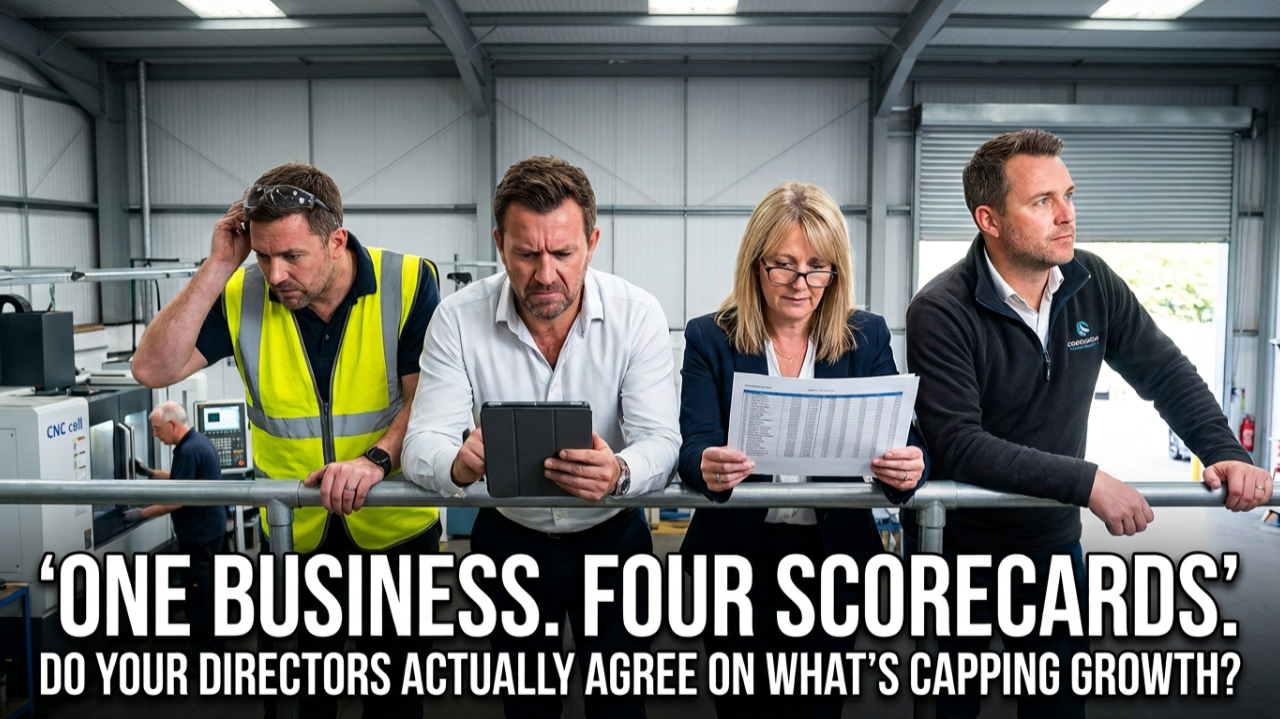
Go back to the hydraulic cylinder business at the start. The objective wasn't badly written. "Grow aftermarket revenue to 30% of turnover" is clear, measurable and sensible. Both directors would have voted for it. The problem was that each of them carried a different picture in their head of what it meant, and the wording was vague enough to hold both pictures at once. That's exactly what false alignment looks like. Nobody lied. Nobody was difficult. They just never compared the pictures.
If you've ever run a gauge study, you'll recognise the fix. When two inspectors measure the same part and get two different readings, you don't argue about the part. You check the gauge. An objective that two directors read two different ways is a gauge problem. And the only way to find it is to have both of them take a reading, separately, and compare.
What a good 10-day check looks like
In the Implementation Engine, the Blueprint workshop is where your team identifies the handful of Critical Success Factors that will make or break the next year, and turns them into company and team objectives with two to four OKRs. That becomes the core of your VTA Matrix™, the one-page operating system you use every Monday. The 10-day check comes, unsurprisingly, about ten days later.
Why ten, and not the next morning? Because you want one real working week to test the plan against. Long enough for the first actions to have started, or to have conspicuously not started. Short enough that nothing has hardened and nobody's emotionally invested yet. It's the sweet spot, I think.
Here's roughly how I'd run it. Allow a couple of hours, somewhere away from the shop floor, with phones switched off and left in a different room if you can manage it.
Restate every objective on separate sheets. Before anyone talks, each director writes down, on their own, three things for each objective: what it means in plain words, what success looks like at 12 months, and the first thing they personally will do about it. Then you read them out. This is the gauge study. Where the sheets match, brilliant, move on. Where they don't, you've just found your hydraulic cylinder problem on day 10 instead of day 90. It's often a bit awkward, and honestly that awkwardness is the whole point.
Check that every key result can actually be measured, now. This catches more than you'd think. I worked with a marine engineering business on the south coast, about £7m turnover, whose key result was on time in full deliveries up to 95%. Sensible target. At the 10-day check, someone asked what the figure was today. Silence. It turned out their system recorded the date the customer had asked for, but not the date they'd actually promised, so nobody knew the starting point. The quality manager tracked it by hand for four weeks and they had a real baseline by day 30. Without the check, they'd have arrived at day 90 with no number at all, and a very confusing review.
Walk the first 90 days of actions by owner, not by objective. Most plans get written objective by objective, which hides a simple problem: the same names keep turning up. So list every action under the person who owns it. At a materials handling business, around £16m, this showed that the production manager owned 11 of the 28 actions. He was also covering for a planner who'd just retired. Nobody had planned for him to fail. It just added up that way. The fix took about 20 minutes of fairly straightforward conversation. Four actions moved to other people, and two were deliberately pushed into the next quarter. That's a capacity check, really, the same one you'd do before accepting a big order.
Say out loud what you're stopping. If your 12-month objectives are genuinely new, something else has to give. A project, a standing meeting, a customer request you'd normally say yes to. If nothing's being stopped, the new plan is quietly competing with everything you were already doing, and you can probably guess who usually wins.
Look honestly at the first ten days. This isn't about judging anyone; it's about seeing whether the plan has survived contact with an ordinary, unremarkable working week. If an action hasn't started by day 10, in my experience it's rarely laziness. It's usually that the action wasn't clear enough to start. "Review pricing" can't be started. "Pull last year's margin by customer and bring the bottom ten" can.
Finish with an explicit yes. Each director says, out loud, that they agree with the objectives and that they own their actions. It can feel a bit theatrical the first time. It isn't, though. The BCG authors argue that the leadership teams who get change right make specific, explicit agreements rather than relying on a general sense that everyone's on board. A spoken yes in front of your colleagues is a very different thing from a nod at the end of a long day.
You'll notice none of this is about scores or progress percentages. That's deliberate. Day 10 is about agreement, not performance. If you try to turn it into a mini review, people start defending numbers instead of comparing pictures, and you lose the one thing the check is for.
So what are the 30, 60 and 90 for?
If day 10 is the most important check, does that make the others box ticking? Not at all. They just do different jobs, and those jobs make far more sense once you know the plan was agreed in the first place.
Day 30 is about evidence and early wins. There's some lovely research from Wharton on what's called the fresh start effect. Hengchen Dai, Katherine Milkman and Jason Riis found that people are much more likely to act on goals just after a landmark, like the start of a new week, month or year. Your launch gives you exactly that burst of energy. The trouble is that a burst is all it is, and it doesn't last. So day 30 is where you replace launch energy with proof. Are the leading measures starting to move? What's actually got done? Teresa Amabile and Steven Kramer analysed nearly 12,000 diary entries from 238 people and found that making progress on meaningful work, even small progress, was the single biggest boost to how people felt about their work. Setbacks were the biggest drag. Day 30 makes the small wins visible, so people keep going.
Day 60 is about the middle. There's a well-known dip here. Research by Andrea Bonezzi, Miguel Brendl and Matteo De Angelis found that motivation tends to be higher near the start and near the end of a goal, and sags around halfway, when both the start and the finish feel a long way off. Add Gersick's finding that teams naturally reconsider their approach at the midpoint, and day 60 lands just after the moment your team will want to rethink things anyway. So make the rethink deliberate. What's working? What should be dropped, swapped or reset? It's far better to adjust the plan on purpose at day 60 than to let it drift on its own at day 45.
Day 90 is about learning and the next 90. You score the quarter, check it against the 12-month OKRs, and agree the actions for the next 90 days. Here's the thing I've noticed, though. A day 90 that follows a proper day 10 is usually a fairly calm meeting. You're discussing results, not discovering misunderstandings. A day 90 without one is, far too often, an autopsy.
And honestly, this matters more right now, not less. The S&P Global purchasing managers' index for UK manufacturing rose to 52.8 in October, up from 51.9 in September, and Reuters reported that manufacturers started the final quarter with their strongest output growth in more than two years. Costs are still climbing, though, and supply chains are still bumpy. That's good news for order books. But think about what a busier factory does to a strategic plan. When the shop floor is flat out, the actions that aren't urgent get pushed back a week, then another week. Growth is precisely when you need the plan to have been properly agreed, because nobody will have time to argue about what it meant later.
The check that decides the quarter
So here's where I've landed after a good few years of watching plans either take hold or quietly fade.
The 10, 30, 60, 90 rhythm works because each check does a different job. Day 10 makes sure your leadership team genuinely agrees on its 12-month objectives, its key results and its first 90 days of actions. Day 30 replaces fading launch energy with evidence and small wins. Day 60 meets the midpoint slump head on and changes the plan on purpose. Day 90 scores the quarter and sets up the next one.
But day 10 is the one that everything else rests on. Plans tend to start wrong rather than go wrong. The first meeting sets a pattern that holds until halfway. Leadership teams think they're aligned far more often than they are. And a misunderstanding gets more expensive with every week it travels, the same way a defect does.
If you've had your strategy day this autumn and you're still inside the first couple of weeks, here's a small challenge. Get your leadership team together this week, hand everyone a blank sheet, and ask each person to write down what your top objective means, what success looks like in 12 months, and the first thing they'll personally do about it. Then read them out. If they match, great. If they don't, you've just saved yourself a quarter. And if you're already past day 10, do it anyway. It's still a lot cheaper now than at day 90.
If you'd like some help building the whole rhythm properly, that's exactly what our
Implementation Engine is for. It's a 90-day programme for UK engineering and manufacturing firms turning over £3m to £25m, for leadership teams whose strategy is sound but keeps getting lost in what we call the Fog of Daily Chaos. We start with a Deep Dive diagnostic and a hands-on Blueprint workshop, build your VTA Matrix™ with two to four OKRs, KPIs, and an owner and deadline on every action, and then hold the rhythm with structured check ins at 10, 30, 60 and 90 days. They're non-negotiable pit stops, and the first one is where we make sure your team has actually agreed, not just nodded. The full programme is £7,500 plus VAT, with payment options available.
Or if you'd just like to talk it through first,
book a free 30-minute call. It's a conversation, not a sales pitch.
The 90-day review tells you how the quarter went. The 10-day check decides it.
Pay It Forward! Sharing Is Caring!